 ESPCI web site



Proposition de stage
Laboratoire Sciences et Ingénierie de la Matière Molle, (SIMM)
Adresse : ESPCI, 10 Rue Vauquelin 75005 Paris
Directeur du laboratoire : Jean-Baptiste d’Espinose
Responsables du projet :A. Fruh, J. Comtet, N. Sanson, B. Bresson
Contact : 
In collaboration with Saint-Gobain Research
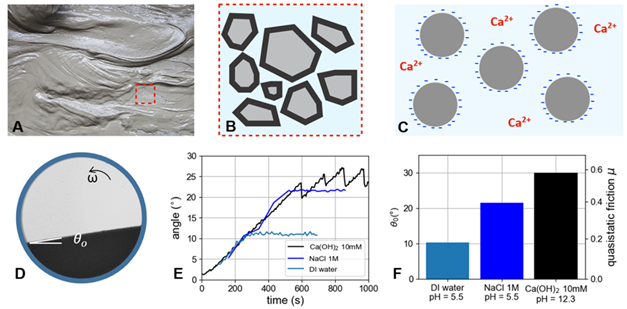
Figure. (A) Cement paste. (B) Local microstructure with interacting micrometric grains. (C) model suspension considered : silica particle in a controlled aqueous medium. (D) Rotating Drum Experiment at a fixed angular velocity ω. (E) Evolution of the avalanche of the suspension in the rotating drum for different physico-chemistry. (F) Avalanche angle of the steady state and quasistatic macroscopic friction coefficient.
Cement-based materials are ubiquitous but raise major concerns with respect to their environmental impact in terms of CO2 emission. The development of new binders, more sustainable than traditional cements, requires better understanding of the physical mechanisms behind their behavior. On the academic side, these complex materials can be seen as dense suspensions of interacting particles (Fig. B), with their macroscopic behavior accordingly set by the physiochemical formulation of paste, through its action on the local nanoscale mechanical interactions between grains (adhesion, friction, etc…).
In collaboration with Saint-Gobain Research, we are currently working to quantify these local interactions at nanometric scales using Atomic Force Microscopy techniques. This internship, also in partnership with Saint-Gobain, will focus on the macroscopic behavior of particle ensembles, specifically examining the impact of formulation. To achieve this, we will use rotating drum experiments (see Fig. D-F) and standard rheological techniques. A key objective is to explore the role of more complex physico-chemical interactions by introducing reactivity and additives, such as polymers. In the long term, our approach aims to develop novel methodologies that link nanoscopic measurements to the interplay between material formulation and rheology. This connection is crucial for advancing the development of more sustainable construction materials.
We are looking for a student strongly motivated by experimental work involving rheology experiments, and with a strong background in physics (soft matter, hydrodynamics, mechanics) or physicochemistry.
References.
– Guazzelli É, Pouliquen O. Rheology of dense granular suspensions. Journal of Fluid Mechanics, 852:P1 (2018).
– Comtet, J. et al. Pairwise frictional profile between particles determines discontinuous shear thickening transition in non-colloidal suspensions. Nat Commun 8, 15633 (2017).
– Bonacci, F. et al. Contact and macroscopic ageing in colloidal suspensions. Nat. Mater. 19, 775–780 (2020).

- Download the document